
Metric One
70.19%
Average documented online shopping cart abandonment rate tracked by Baymard.
E-Commerce Brands Already Communicate Across Every Stage Of The Funnel.
But Revenue Still Leaks When The Customer Has Intent And The System Cannot Answer Fast Enough.
A Shopper Wants Delivery Clarity Before Paying.
A Buyer Wants Return Confidence Before Checkout.
A COD Order Needs Confirmation Before Dispatch.
A Payment Fails And The Customer Disappears.
An Order Is Delayed And Support Gets Flooded.
A Return Request Turns Into A Trust Problem.
The Communication Gap In E-Commerce Is Not Lack Of Messaging.
It Is The Absence Of A Connected Layer That Can Convert Intent, Resolve Uncertainty, Recover Failed Moments, And Protect The Customer Relationship After Purchase.
Metric One
Average documented online shopping cart abandonment rate tracked by Baymard.
Metric Two
E-commerce sites rated “mediocre” or worse in checkout UX in Baymard’s benchmark.
Metric Three
Potential conversion-rate lift Baymard links to better checkout UX on average large-scale sites.
Every One Of These Moments Adds Doubt. And Doubt Is Expensive.
E-Commerce Teams Spend Heavily To Generate Demand, Move Shoppers Through Discovery, And Bring Them To The Point Of Intent. But When Communication Is Disconnected From Inventory, Logistics, Payments, Returns, And Support, The Customer Is Forced To Decide Without Clarity.
That Is Where The Sale Breaks.
E-Commerce Communication Cannot Remain Limited To Alerts, Reminders, And Campaigns.
It Has To Behave Like Revenue Recovery Infrastructure.
It Must Understand What The Customer Is Trying To Resolve.
It Must Retrieve The Right Commerce Context.
It Must Answer With Confidence.
It Must Trigger The Next Action When Possible.
And It Must Know When A Human Needs To Step In Before The Customer Leaves.
Most Carts Are Abandoned Before Purchase
Baymard Tracks The Global Average Cart Abandonment Rate At 70.19%, Based On 49 Different Studies.
Checkout UX Still Underperforms Across Major E-Commerce Sites
Baymard's Benchmark Found 65% Of Sites Perform Mediocre Or Worse In Checkout UX, With Only 2% Rated Good.
Better Checkout Experience Can Materially Lift Conversion.
Baymard's Benchmark Says The Average Large-Scale E-Commerce Site Can Potentially Gain A 35% Conversion-Rate Increase Through Better Checkout UX.
Customers often need a specific answer before buying: when it will arrive, whether the address is serviceable, and what happens if delivery fails.
A vague return policy can make the customer delay purchase, abandon the cart, or open a support conversation before checkout.
A failed payment is a live recovery moment. If the customer is not guided immediately, intent fades.
Unverified cash-on-delivery orders create avoidable dispatch cost, RTO risk, and inventory lockup.
When customers do not know where their order is, they create repeat tickets across WhatsApp, SMS, email, and social channels.
A refund may be operationally in progress, but if the customer cannot see status, the brand feels unresponsive.
The old model is simple: campaign sent, customer expected to buy.
That is no longer enough.
An e-commerce-grade communication layer should recognize buying intent, retrieve commerce context, resolve uncertainty, trigger recovery workflows, and escalate when a human is needed.
It should help the customer choose, checkout, pay, confirm, track, return, refund, or speak to support without restarting the conversation.
This is not about sending more promotional messages. It is about protecting the revenue already created by customer intent.
 :
:Identify delivery, return, payment, refund, COD, discount, order, product, or support intent.
Match customer, cart, order, SKU, inventory, address, payment, logistics, and prior conversation context.
Answer uncertainty with specific information, not generic policy links.
Trigger payment retry, cart recovery, COD confirmation, delivery reschedule, refund status, or support workflow.
Send the customer a clear next step or completed-action confirmation.
Move complex, high-value, angry, or exception cases to support with full context.
Move complex, high-value, angry, or exception cases to support with full context.
Send the customer a clear next step or completed-action confirmation.
Trigger payment retry, cart recovery, COD confirmation, delivery reschedule, refund status, or support workflow.
Carry purchase, support, return, and refund history into the next conversation.
connects shopper conversations to commerce operations.It is the communication layer between customers, storefronts, payment systems, logistics providers, CRMs, and support teams.
It helps e-commerce brands understand shopper intent, retrieve order and cart context, resolve routine questions, recover failed purchase moments, and escalate high-value or complex cases with full briefing.
Across WhatsApp, SMS, RCS, Instagram, and Telegram, the shopper conversation remains connected to the revenue journey.
Recognize delivery, return, payment, COD, refund, product, discount, order, and support questions before routing or responding.
Connect conversations to cart state, order status, SKU, customer profile, logistics, payment, and prior support history.
Guide customers after payment failure, retry links, UPI issues, wallet problems, or abandoned checkout moments.
Confirm intent before dispatch, reduce avoidable delivery failures, and help customers reschedule where supported.
Give customers status-specific answers instead of generic refund policy replies.
Escalate high-value, angry, or exception cases with order, cart, payment, and conversation history attached.
Intent becomes a confirmed checkout.
Resolution Path
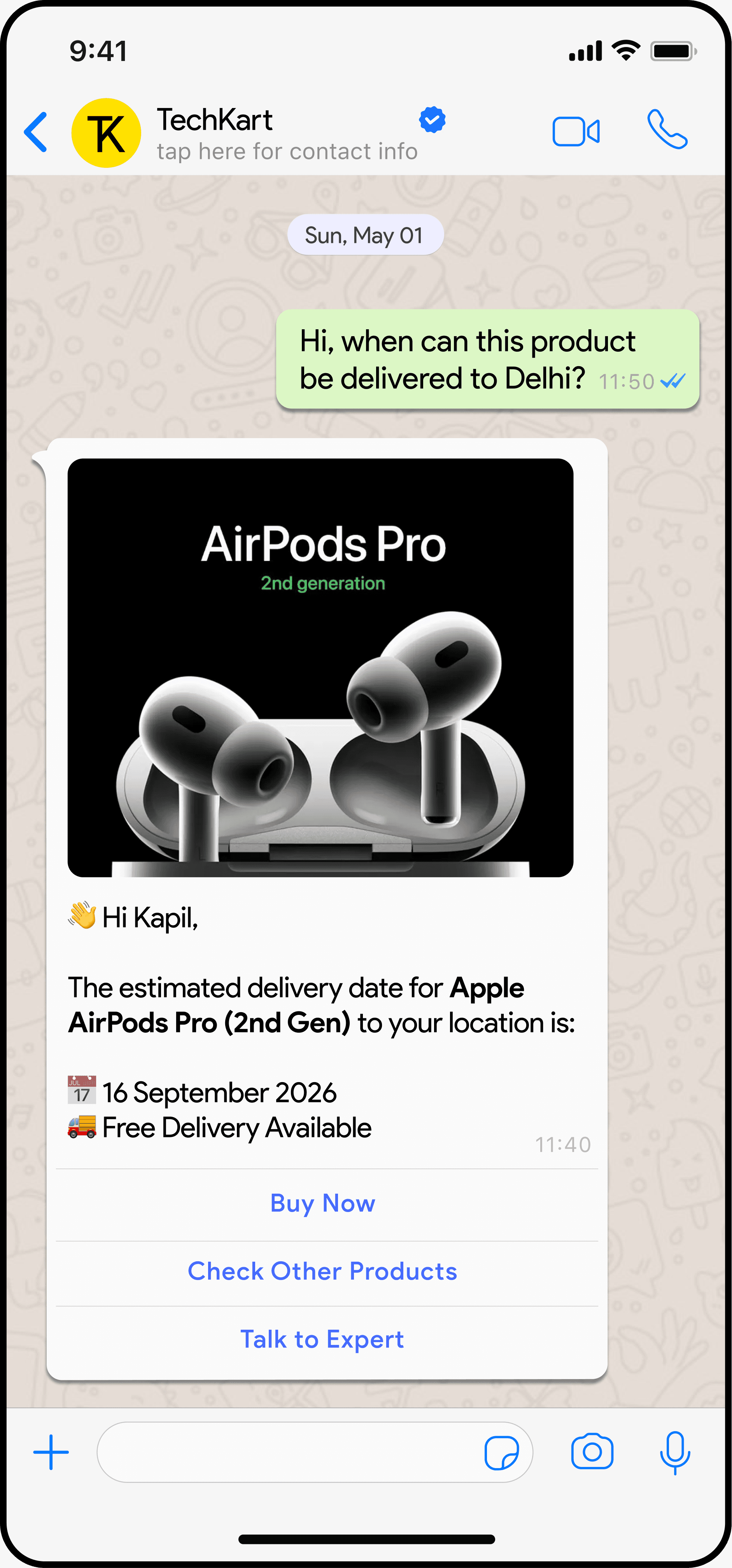
Dootiq identifies delivery-intent, checks SKU, address, inventory, and logistics promise, then gives a specific delivery answer or routes the customer to an assisted checkout path.
Outcome
The customer gets the confidence needed to complete the purchase.
E-Commerce Teams Cannot Treat Customer Conversations Like Generic Support Tickets.
The Communication Layer Must Protect Customer Trust While Preserving Operational Context.
Was The Alert Delivered?
Did The Customer Get Enough Clarity To Continue, And Can The Brand Show What Happened?
Customers should not repeat order numbers, payment details, or delivery issues across channels.
High-value, angry, delayed, lost, or policy-exception cases should move to support with complete context.
Purchase, support, delivery, return, and refund history should remain available for the next interaction.
Status, timing, and next-step clarity should be visible to the customer at every stage.
Editorial Article
E-commerce brands already communicate across every stage of the funnel.
But more communication does not automatically protect more revenue. The real question is whether the customer receives the right answer at the moment intent is still alive.
Enterprise cloud communication built for security, scalability, and intelligent engagement.